Be yourself; Everyone else is already taken.
— Oscar Wilde.
This is the first post on my new blog. I’m just getting this new blog going, so stay tuned for more. Subscribe below to get notified when I post new updates.
Be yourself; Everyone else is already taken.
— Oscar Wilde.
This is the first post on my new blog. I’m just getting this new blog going, so stay tuned for more. Subscribe below to get notified when I post new updates.
Intrinsic Appreciation:
After interviewing a few people, the team found out a few things that were very useful to understand who the unsub was, and what got him to do everything that he was doing to the victims. For example, after the team landed on Portland, Oregon, the team split. Some went to interview a few witnesses and others went to the police station. The ones that went to interview the witnesses, found out the unsub was wearing a set of weird looking eyewear to help him see during the night and was wearing black clothes. This specific information helped with the teams’ work and helped them with getting closer to finding the unsub faster before he killed anyone else.
Extrinsic Appreciation:
As the team went on doing their research, especially of the doctor, they found out that the doctor treated all kinds of therapy on the patients to help them get over their fears. The doctor (who was killed by the unsub) let go of this patient because the doctor was using this form of therapy that wasn’t working on his patient. After the doctor let the patient go, the parents kept on doing the therapy on their son, which led their son to suicide. His fear led him to kill himself. The team felt some sort of sympathy towards the doctor but also for the kid that killed himself.
Intrinsic Evaluation:
After the team found out certain criteria about the unsub, they went and gave the profile of the unsub to the police squad that are working with the team to capture the unsub. They evaluated the unsub based on an interview that they had. The person they interviewed was one of the neighbors that lived right across from the victims’ house.
Extrinsic Evaluation:
Criminal Minds has been a very successful show for many years. This show has shown many scenarios of different people and explain why they do certain things the way they do it. It helps us, the audience, to understand different perspectives and this is what makes this show a successful program. Also, their main characters help make the show a little more interesting as well. Each character has its own story, have their ways of being them, and that also helps the show be the show that it is.
One Media From that I have previously written about is Criminal Minds, season 14 episode 11 called “Night lights”. On this specific episode , there are several elements from Dewitt Parker’s Logic of Aesthetic Forms that are presented. These elements are Thematic Variation, Evolution and Hierarchy.
Thematic Variation:
Within Thematic Variation Eliseo Vivas mentions, “the variation of the theme aids it in providing the striking quality required to shock attention, to surprise it, and to present it with some degree of difficulty, without which it would become lax through boredom”. This helps us understand the difficulty that this killer went through to get all of his victims, the difficulty that the victims go through to escape to only being recaptured and to be killed. The shocking part being that the killer wants them to escape so he can see them struggle in the dark due to the fact that he turns off all of the lights in the victims house.
Duration:
Throughout the episode, it doesn’t show us the audience right away why the killer is the way he is, but it builds up by giving the audience some suspense. The duration on how long it takes to reveal the killer and why he does what he does, is very important, it helps us understand why things happen the way they do, and how things happen the way they do.
Hierarchy:
Hierarchy is shown in this episode due to the dominance that the killer shows throughout the episode. The dominance that the killers presents throughout the show, at some points were misleading due to the fact that at one point, he holds up from killing a girl he captured just because she was comforting him with words. This goes to show the audience one or maybe some of the killers weaknesses. The girl at some point dominated him with words that reminded him of a memory that lead him to start all of the killings.
Criminal Minds is a show played on CBS since 2005 and its last episode was on February 19, 2020 and it was produced by Jeff Davis. This is one of my favorite shows and I watch it on Netflix! According to CBS, it states “Criminal Minds revolved around an elite team of FBI profilers who analyze the country’s most twisted criminal minds, anticipating their next moves before they strike again”. This show helps you understand and/or signifies how might criminal think according to their past or any disease that might have been hunting them since they were born. On season 14, episode 11 is called “Night Lights”, this episode is about a guy or unsub who is visually impaired. He has been like this since he was a child and went through a lot to which he suffered. He would shut off the power of the victims house and this cause the victims to walk around their house in the dark which would make them touch everywhere so they won’t hurt themselves. The unsub wears night vision goggles so he can see the victims walk around and then he would grab them and tape them up to a table laying down so then he can make them suffer by pouring liquid that would burn their eyes and so they can be visually impaired as well. He would also let one of the victims go so then he could run after them and stab them multiple times with a knife. He does all of this because ever since he was visually impaired, no one ever showed him empathy so to him anyone that would show empathy towards him, he would act out and basically just make his victims suffer and make them feel his pain.
Semiotics goes along with this episode because the unsub is showing signs where he has suffered, in this case he is visually impaired. This signifies a part of communication which is very important for us as human beings. It also shows a part of semiotics which is a sign, that the unsub was unintentional which means that the unsub was showing signs of some sort of medical condition.
In the ethnic group that my parents and I belong to is Hispanic or Latino and there are certain social media platforms that Hispanics visit all the time. For example, in my household my parents number one social media platform is Facebook and through here they are able to communicate with family from their country of origin. Facebook is known all over the world and therefore is used by every type of race and one of facebooks main used social media platform is by the Hispanics and Blacks as well. Along comes Instagram behind Facebook; Instagram is also another social media platform that is used by Hispanics daily.
On this article named “Social media preferences vary by race and ethnicity”, it shows how it varies between Latinos, blacks and whites while using different social media platforms. On the graph shown below, it shows that conparison of different races and the different types of social media platforms that that is being used on a regular. As it is shown, Facebook has the highest percentage of usage being 73% compared to Blacks, Whites and other races. Instagram comes behind Instagram but, Blacks have the higher percentage at 38% of usage, Latinos have a 34%, Pinterest is used by Whites more compared to the other races with a percentage of 32% and all other races have a percentage of 28%. On the case of LinkedIn, it is shown that Latinos do not really use this social media platform as much as the other races; they amount of usage is 18%, which is the lowest compared to the other races. Blacks and all other races are at the same percentage of 28% and whites with a percentage of 29%.
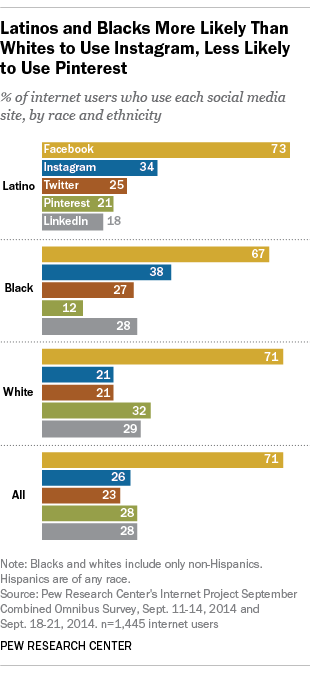
This graph is a great example to show us the comparison of different races and the usage different social media platforms. Personally, my main social media platforms at the moment are Instagram and TikTok, and maybe sometimes Facebook just so that I can connect with my family and friends from my country Dominican Republic. All of the various types of social media that there is are made to connect with others in different ways and I believe these companies are giving the consumers what they know they will like and what they need.
Lately due to everything that is happening with Coronavirus (COVID-19), I have been gravitating towards the nytimes website just to be informed. One article that caught my attention was this one, called “New York Was Not Designed for Emptiness”. Just the name of this aticle calls for attention, because people never hear of New York, the city that never sleeps being “Empty”.

Out of the 7 Gratifications Factors, two of them speak out to me when I read this article, Information and Problem-solving gratification. This article gives us the inside look of how the New York City is looking without us the audience actually having to be there, as New York City is one of the cities that has the most high cases on COVID-19. The streets are literally empty, parks are empty, public transportation for example trains are rarely being used. The only businesses that are really open are the essential ones, basically the ones that sale food like supermarkets, bodegas, and pharmacies and that is where you really see people. But you see people with protective gear as in masks, gloves, etc. This serves under the Informational gratification factor. Another Gratification factor that I see that can be used would be the Problem-Solving Gratification Factor. This is because the Governor of New York City has asked all citizens to stay home and to only come out of there house ONLY if necessary to go and get things that are needed in the house. Because the Governor Cuomo has established all of these rules, most of New Yorkers are listening and thats is why the streets are as empty as they are, which is what is needed from the citizens all over, to stay home!
I believe that media institutions can do a better job at targeting or tapping into the consumer gratifications I mentioned above by listening to the authorities more but also listening to the citizens. I know that the News stations always give out a number where their audiences can call in with their opinions or suggestions, it is a way that the citizens can communicate with everyone and so their questions can be answered faster.
After watching the short scene from an episode of Studio 60 on the Sunset Strip, if I would have been in control of the control room with the crew, I would have been the corporate executive who wanted it to cut the show. This is because there is a lot that was set by the host where it would have hurt the shows reputation or just the show itself. Host have to be very careful what they say and how they say it because it can affect the show in so many levels. In our book “Media Criticism” on chapter 7, it states “An old producer once said: “In my drawer are all the projects I want to do. What you see on the screen are the things they’ll buy” (Page 178, electronic book). The host that got up and kicked out the two people that were presenting their skit, was not directed to do that but he still did it anyways. Whatever got him to say everything he did, was really affecting the program of the show. Since it was something that was not planned for the program of that episode and as a producer, we would not have known where the host was going with what he was saying, I believe that as a corporate executive, I would have cut the show since the start. Nobody knew what he was about to say or how bad it was going to get, so as a corporate executive, I would have cut the show since it could have hurt the show even financially.
As you watch the show as the host was speaking, you can feel the intensity in the room and how the host really took everyone by surprise by everything that he was saying, until the director of the control room finally decided to cut the feed because the host started to mention really bad things basically about everyone.
One of the podcast that I listen to is called “Straight Up with Trent Shelton”, a production of The Hollis Company. This podcast the Host, Trent Shelton speaks about various topics and one of his latests podcasts is called “Who Are You Refusing To Forgive”. In this episode Trent Shelton speaks about how to forgive people but most importantly he speaks about how to forgive yourself. One of the things that he mentions that really impacted me was, “Weak people hold grudges. Strong people forgive”. This is something that to me is very true in many ways.
There are some individual ingredients that this podcast touches on, these being the music/sound ingredient, the On-Stage talent ingredient and the Production (“Stage-molding”) ingredient. The music/sound ingredient was used very well. Trent Shelton used the four ingredients for this, which are clarity, execution, continuity and aptness of tase. The clarity of the music and the mic that were used was very clear, the music was not too loud or too low. He also gave really good examples on how things can happen if you don’t forgive and just hold grudges. Trent continued by grabbing the audiences attention with in between his episode he gave commercials with music and giving announcements. He stuck to his topic all throughout the episode.
By just listening to Trent Shelton (Host), you can notice his On-Stage talent, he is a very outgoing person. He knows how to grab peoples attention very well, he has a good way of connecting with his audiences by bringing up topics that makes the audience intriged. Also by bringing up topics that really makes his audience think.
The Production (“Stage-molding”) of the podcast was clear. The way that Trent used the transitions from the starting of the episode, which had music and transitions to Trent introducing the merchandise he is selling, to then speaking about the topic of the episode. Throughout the episode there are breaks which sounds like a commercial with music. At the end, Trent ended the episode with music as the same way that he started the episode.
The 2020 Academy Awards show was a tough one this year. I will be critiquing the following article by Richard Lawson, called “The 2020 Oscars Stayed on Script, Until They Didn’t”, on the Process perspective which are the Message Criticism, Medium Criticism, Receiver Criticism and Originator Criticism: https://www.vanityfair.com/hollywood/2020/02/oscars-2020-show-review-parasite-wins
Message Criticism: The overall message that Richard Lawson wanted to convey was that the Academy Awards did not play as it usually do compared to the past years. This Academy Awards that past according to Lawson was awkward for most of the time. Lawson mentions that performer Janelle Monae had to work extra hard to get the audience motivated or pumped up. It was like the audience were not feeling the Academy Awards at all!
Medium Criticism: The way that the Academy Awards was played was many performances by Janelle Monae, Eminem which surprised everyone by performing his old songs or “throwbacks”, Utkarsh Ambudkar and other performers. Christ Rock and Steve Martin came out several times making jokes about the complaints that people were making of the Oscars, which at the end, they both ended up being the hosts of the Oscars. In between all of this, they were naming the nominees and winners of the each category. Towards the end, they movie called “Parasite” won two awards “Best Picture”, “Best Director”, “International Feature Film” and “Writing”, which surprised a lot of people, it was really unexpected.
Receiver Criticism: Before the Oscars were given, there were complaints that people were making just because they announced that there was not going to be any hosts in this years Oscars. But throughout the Oscars, Chris Rock and Steve Martin ended up being the hosts of the night. When the Oscars announced that they were not going to have a host or hosts, it really made a difference on how people perceived the Oscars or at least they way that people were thinking of it, because it is basically a tradition to have a host or hosts.
Originator Criticism: AMPAS (Academy of Motion Picture Arts) is who puts together the awards or Oscars.
HighSnobiety has a very interesting way with words. In their article “Ranking Every Super Bowl Halftime Show Since 2000 from Worst to Best”, they introduced what seemed to be their honest opinion of an organized list of every Super Bowl Halftime Show since the 2000s. Their tone throughout the article is very straight forward of what sounds like their honest opinion. HighSnobiety’s honesty is played by the way they mention things about each performance. For example, #21 as their first pick which is graded as the worst Super Bowl halftime show, they compared that halftime show as riding one of those boring rides at Disney World that you just get on just to give your grandparents some rest because they been walking all day. That says a lot about HighSnobiety’s critical views because that was cruel! they even go to mention that the performance was not even “enjoyably bad…just bad”. While looking through their rakings of each halftime show performance going down the line, they just kept on getting worse, but towards the end it got good. They finished with Beyonce’s performance which can say a lot about them as well, such as they could potentially be a Beyonce’s fan. HighSnobiety did not even make a long of a comment on Beyonce’s performance, they just commented “Honestly, just bow down”. One of the things that suprised was that Beyonce was higher on the list than Prince. One thing that struck me was that the halftime show for the Super Bowl that just happened did not make it to his raking of Top 5, it was actually his 7th best. J Lo’s and Shakira’s performance in HighSnobiety’s honest opinion was a “stupendous celebration” just because they both celebrated the Latin American heritage. HighSnobiety is using honestly as their media critique as stated above. They were very straight forward with their commentary and what they thought of each performace, in other words, they did not hold off anything that came to mind when they were writing this article.
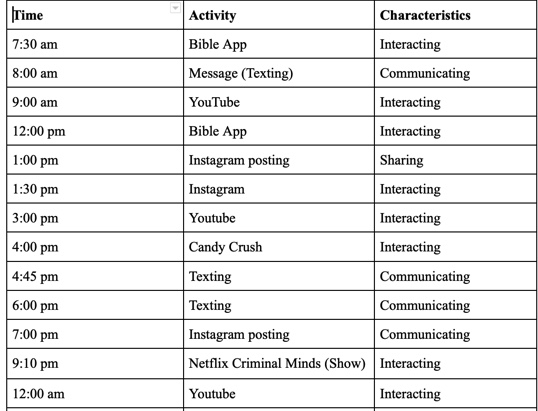
WHAT IS CRITICISM, you may ask? According to Peter B.Orlik, Criticism is a destructive weapon rather than a constructive tool. There are two types of criticism, Legitimate and Constructive. Legitimate criticism points out defects but describes why certain things are defective. Constructive criticism is more about knowledgeable comprehension or “carefully considered judgment”. All of this connects to us because Media criticism is something that we are all surrounded by and we do every day. Media affects the way we react, and most importantly, the media tells our story! Through our everyday life, people tend to be on their phones most of their day literally everything. Through our phones, we get to share things with our family & friends, we get to socialize and communicate, but also interact. Through all of these four things, we as users tend to be critics. According to Peter B. Orlik, he states that the act of criticism involves organizing, describing, analyzing, interpreting and evaluating. Without us even noticing it, while we text someone or are using social media, we are doing all of these things. During the day of Friday, January 31st, 2020 I was observing myself of the usage of my phone in general. It made me come to the realization that there was a lot of interacting and communicating through these apps. I have realized a lot just writing down how many apps I used during the day, or texting people. After putting together the chart of my media usage, it makes you realize how you start your day, and how you end it and that is by using your phone or some sort of media, like in my case was either Netflix or YouTube. Nowadays it is a habit of ours and we don’t realize it! I started my day by using the Bible App for about 30 minutes, then went on to texting with family members and friends. Throughout the day, I found myself using YouTube and Instagram, but also playing some Candy Crush to get my mind off of things. And finished the day watching some Netflix until I fell asleep.

 Media Criticism